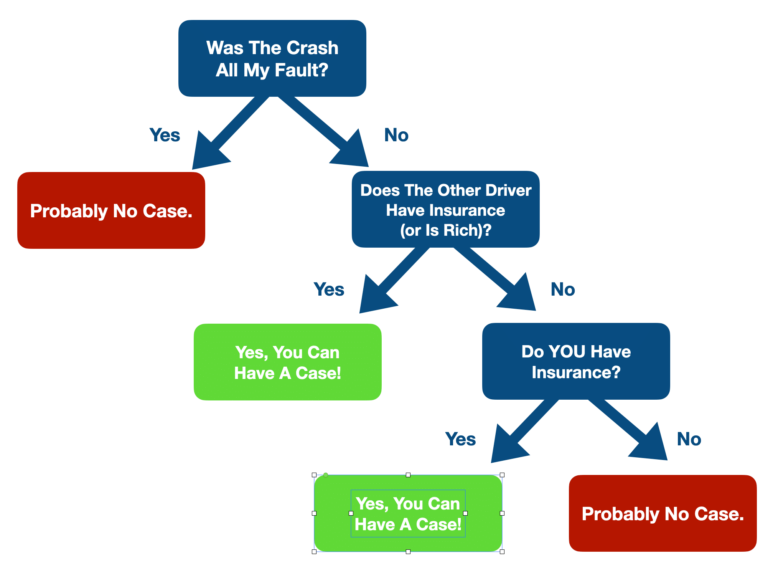
This is one of the biggest misconceptions in personal injury law, and it stops people from getting the money they're owed every single day. Someone gets rear-ended at a red light. They're hurt — neck pain, back pain, headaches. The other driver was clearly at fault. But the injured person doesn't have auto insurance, and they assume that means they can't do anything about it. They don't call a lawyer. They don't go to the doctor. They suffer in silence because they think they gave up their right to be compensated when they let their insurance lapse.
That is dead wrong.
I've been handling car accident cases in Illinois for close to 30 years, and I've represented plenty of clients who didn't have auto insurance at the time of their accident. Their cases settled for the same amounts as cases involving fully insured clients, because the value of a personal injury case has nothing to do with the injured person's insurance status. It has to do with the other driver's negligence and the severity of your injuries. Period.
Here's how it works legally. When someone else causes a car accident and injures you, their liability insurance pays for your damages. Your claim goes against their policy, not yours. Your insurance — or lack of it — is irrelevant to the liability analysis. The question is simple: did the other driver cause the accident, and were you hurt? If the answer to both is yes, you have a case.
Now, I want to be straight with you about the practical challenges. Not having insurance does create some complications, even though it doesn't kill your case. The first complication is medical treatment. If you don't have health insurance either, paying for medical care while your case is pending can be difficult. We work with medical providers who treat on a lien basis — meaning they provide the care now and get paid out of your settlement later. This allows you to get the treatment you need without paying out of pocket.
The second complication is the missing uninsured motorist safety net. If you had your own auto insurance with UM/UIM coverage, and the at-fault driver had low limits or no insurance, you could tap your own policy to make up the difference. Without that coverage, you're limited to whatever the at-fault driver's policy provides. If they only carry the Illinois minimum of $25,000, that might be all that's available — and for a serious injury, $25,000 doesn't go very far.
The third complication is the perception issue. The insurance company's adjuster — and potentially a jury — might view you unfavorably for not having insurance. It's not fair, and in most cases it's not even legally relevant, but it's human nature. A skilled attorney knows how to handle this. We keep the focus on the other driver's negligence and your injuries, which is what the case is actually about.
Here's the bottom line: if you were hurt in a car accident that wasn't your fault, don't let your lack of insurance stop you from pursuing your case. You have the same legal rights as every other driver on the road. The other driver's insurance company owes you money regardless of what's on your policy — or whether you have one at all. Call us at 312-500-4500. We'll evaluate your case for free and tell you exactly what your options are.
Laws regarding car insurance vary by state and this impacts how the claim processes are handled by insurance companies. This is true for drivers that are involved in an accident and are found to drive without car insurance.
States with No-Fault Car Insurance Systems
States that follow the No-Fault car insurance system require persons that are injured in a car accident to seek compensation from their car insurance coverage. Only in limited situations do injured persons in these states file a lawsuit.
Ultimately, each party is responsible for their damages regardless of their fault. This means that each party must use their insurance policies to cater to medical bills and repair their cars.
Nonetheless, there are exceptions to this car insurance law in some states. This is concerning the amount for medical costs that a plaintiff can file a lawsuit against the defendant. For example, states like the District of Columbia and Hawaii have a threshold for medical bills not exceeding the victim’s medical payment coverage.
In Utah, the victim of the accident can file a lawsuit if the medical bills amount to $3000. In states like Missouri and California, you can file a suit for non-quantifiable damages if the at-fault driver was driving under the influence when the accident happened. Another exception is with the state of Louisiana, where you cannot sue for the first $25,000 of property damage and $15,000 of bodily injury.
States with Tort Law
In Tort law, perpetrators of car accidents are sued for all the damages that the injured of the car accident suffers. States that apply tort law give victims of an accident the right to claim recovery for their injuries, damages, and any losses they may have suffered.
If you live in a tort state, drivers at fault are required to pay any property damage, medical bills, and lost wages that the injured person has suffered.
If you live in tort states and don’t have comprehensive car insurance, you can still file a claim with the insurance company of the driver at fault. You can still seek damages for medical costs and property damages from the at-fault driver.
Basically, you will just proceed with your claim as you would if you had insurance. Here is how to pursue damages against the other party:
To claim compensation, you need to send a letter of demand to the at-fault party outlining the damages and the preferred date for the compensation. The letter of demand should include the details of the accident, cost of repairs and injuries, and the demand for payment. You should also include your contact details, the other party’s contact details, registration numbers of both cars, and the final date for which the money should be paid.
If the at-fault driver does not make payment by the demand date, the next step is to commence a claim in court. You can seek the help of a legal professional to guide you on how to start legal proceedings to get compensation.
Another option to pursue damages when you are not at fault is to go directly to the at-fault party’s insurer. You can engage with financial authority to help you lodge a dispute with the insurer. However, you should note that this process may take time and may come with other requirements.

While you can recover damages in an accident caused by another driver, it is important to know that you will face some consequences for not being insured. Of course, the consequences vary from one state to another.
For example, some states like California, Alaska, Michigan, Lowa, Kansas, New Jersey, Oregon, Louisiana, Oklahoma, and North Dakota observe the “No Pay, No Play” rule. According to this rule, there is a limit to the amount of compensation that drivers without insurance can get during an accident.
In these states, the uninsured driver that is not at fault can seek economic damages like medical bills from the liability policy of the other driver at fault. However, they may be limited to seek damages for non-economic losses like pain, missed time from work, loss of quality of life, or suffering.
Also, driving uninsured can make you liable to several fees and fines, depending on your state. Most states will impose a hefty fine of hundreds or thousands of dollars for individuals that drive without car insurance. You may also face legal penalties like license suspension by the Department of Motor Vehicles. Worse still, your driver’s license may be revoked for a few months to one year.
Yes - your lack of insurance does not bar you from bringing a personal injury claim against the at-fault driver. You were injured through no fault of your own and the responsible driver's insurance is still liable for your damages. However, driving without insurance is a separate legal issue that can result in fines and license suspension. I handle the injury claim - what happens with your license and fines is a separate matter entirely.
Not directly - comparative fault in Illinois applies to your conduct in the accident itself, not to whether you had insurance. If you were not at fault for the crash, your settlement should not be reduced because you were uninsured. Insurance companies may try to use your uninsured status to imply irresponsibility, but that argument has no legal basis in calculating your damages. I push back on that narrative hard.
This is a more difficult situation but not hopeless. If the other driver has personal assets, a civil judgment against them is still possible - collecting it is another matter. If your own vehicle had any insurance, review the policy carefully. Some situations involve third-party liability - a government entity for a road defect, an employer if the other driver was working. I evaluate every possible source of recovery in these cases.
The same things any accident victim should do - call 911, get a police report, seek medical attention, document the scene, get witness information. Do not admit to being uninsured at the scene beyond what the police report requires. Call me before you speak to any insurance company. Your injury rights exist independently of your insurance status. 312-500-4500.
Illinois requires drivers to carry minimum liability coverage, and that minimum is well below what a serious injury actually costs. Because you did not have your own auto insurance, you also did not have an uninsured motorist (UM) or underinsured motorist (UIM) policy to make up the difference if the at-fault driver carried only the minimum. That means the practical ceiling on what you can recover from the at-fault driver's insurance is whatever their policy limits are. Identifying every additional coverage source - umbrella policies, employer policies, government claims if a road defect contributed, household-member auto policies in some cases - is one of the most important early steps.
Yes, potentially. Driving without auto liability insurance in Illinois is a separate violation regardless of who caused the accident. Penalties can include fines, license suspension, vehicle registration suspension, and a requirement to file an SR-22 for several years. These consequences are entirely separate from the injury claim - they do not eliminate your right to sue the at-fault driver, but they do happen on a parallel track. I handle the injury case; the licensing consequences are typically handled by a traffic or administrative attorney.
Two years from the date of the accident under 735 ILCS 5/13-202. The statute of limitations does not change based on the claimant's insurance status. If the at-fault party is a governmental entity or you were hit by a transit vehicle, shorter notice deadlines under the Illinois Tort Immunity Act apply - sometimes as short as one year. Do not let your uninsured status cause you to delay calling a lawyer. The clock runs the same whether you had insurance or not.
In many cases, yes. There are medical providers in Illinois who will treat injury patients on a letter-of-protection or lien basis - meaning they provide the care now and are paid out of the settlement at the end of the case. This is not available everywhere or for every kind of treatment, but it is common enough in orthopedics, physical therapy, pain management, and chiropractic care that most injury cases find a path to needed treatment. I work with treating physicians and providers to make sure the care gets done so that the medical picture is complete when settlement negotiations begin.
Would you like to know more about car accident no insurance not at fault?
If you or a loved one is dealing with a situation like this, give us a call any time, day or night. We are here to help. 312-500-4500

Scott DeSalvo founded DeSalvo Law to help injured people throughout Chicago and surrounding suburbs. Licensed to practice law in Illinois since 1998, IARDC #6244452, Scott has represented over 3,000 clients in personal injury, workers compensation, and accident cases.
No Fee Unless You Win | Free Consultation | 24/7 Availability Call or Text: (312) 500-4500
>>Read More
Main Office:
1000 Jorie Blvd Ste 204
Oak Brook, IL 60523
New Cases: 312-500-4500
Office: 312-895-0545
Fax: 866-629-1817
service@desalvolaw.com
Chicago and Other Suburban Offices
By Appointment Only