
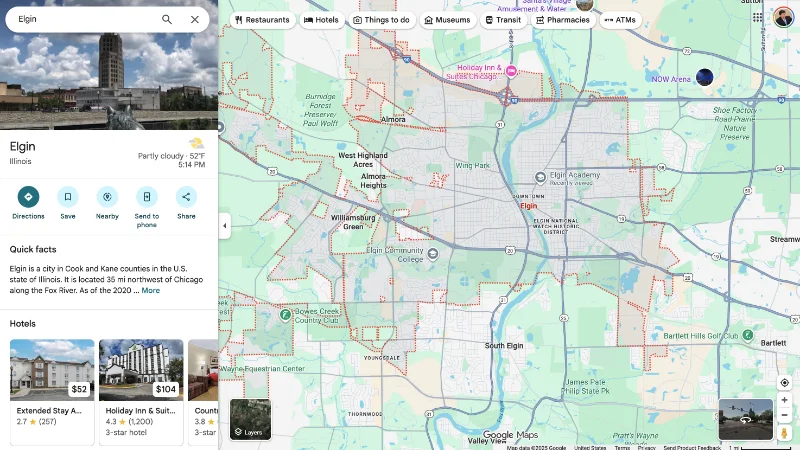



Elgin is a working city. Unlike the bedroom communities that surround it, Elgin has a significant manufacturing and industrial base. Factories, warehouses, distribution centers, and fabrication shops employ thousands of people in jobs that carry real physical risk. When workers are injured on the job, they file workers' compensation claims — and most of them stop there, never knowing that they may have a separate personal injury claim that could be worth far more than workers' comp alone.
My name is Scott DeSalvo. I have been representing injured workers and accident victims in the Chicago suburbs for over 30 years. If you have been hurt at work in Elgin, in a car accident on Route 20 or I-90, or in any other situation caused by someone else's negligence, I want to talk to you. The consultation is free. You pay nothing unless I win. Call 312-500-4500.

Whether you got hurt in a car crash, truck accident or it involved a bicycle, bus, train or even Uber or Lyft, we work hard to get you a top settlement fast!
Workers Comp and Third Party Work Injuries are handled with the best speed and professionalism to get you a fast and full recovery for work injuries.
Fell at a business or got bit by a dog or hurt by someone who was intoxicated? We make sure all the boxes are checked in premises liability cases to get it all for our clients.
Medical errors are the third highest cause of death in the United States, and we take an aggessive, meticulous approach to these most challenging cases to win for our clients.
Nursing home cases can involve falls, mistreatment, or bad medical care, buy they always involve a betrayal of trust, and that's why we pull out all the stops to maximize results for our clients.
Elgin's on major truck routes—I've beaten big trucking companies in cases just like yours. Call us before they hide the black box data.
Workers' compensation is a no-fault system: if you are injured on the job, you receive benefits regardless of who was at fault. That sounds good until you realize what workers' comp does not cover. Workers' comp pays your medical bills and a portion of your lost wages (roughly two-thirds of your average weekly wage, subject to a cap). It does not pay for pain and suffering. It does not pay for loss of normal life. It does not pay for emotional distress. And the lost wage calculation often leaves injured workers significantly short of their actual lost income.
Third-party claims are the key to recovering the full value of a workplace injury. A third-party claim is a personal injury lawsuit against someone other than your employer who caused or contributed to your injury. Your employer is immune from personal injury suits under the Workers' Compensation Act, but no one else is.
Common third-party defendants in Elgin workplace injuries include: Manufacturers of defective equipment or machinery — if a press, conveyor, forklift, or power tool malfunctioned and caused your injury, the manufacturer can be sued for product liability. Subcontractors working on the same job site who created a hazardous condition. Property owners who failed to maintain safe premises when your employer was a tenant or contractor. Chemical suppliers whose products caused toxic exposure. Trucking companies whose drivers caused accidents on your employer's property.
How the money works: Your workers' comp benefits are not reduced when you file a third-party claim, but your employer's workers' comp insurer will assert a lien against your third-party recovery to recoup the benefits they paid. Illinois law requires the workers' comp lien to be reduced by a proportionate share of attorney fees and costs. The practical result is that a successful third-party claim provides significantly more total compensation than workers' comp alone — often two to three times as much. I have handled hundreds of these combined claims over my career, and the difference in outcomes is dramatic.
If you were injured at work in Elgin, do not assume that workers' comp is your only option. Call me, and I will evaluate whether a third-party claim exists. In many cases, injured workers leave tens of thousands of dollars on the table simply because no one told them about their right to sue beyond workers' comp.
Elgin is a full-service city with its own police department, fire department, public works department, and transit system (Pace buses). Kane County operates sheriff's vehicles, highway maintenance trucks, and other government equipment throughout the Elgin area. The State of Illinois maintains highways like Route 20 and I-90 with IDOT vehicles. When one of these government vehicles causes an accident, the rules are different — and the deadlines are much shorter.
The notice requirement is the most critical difference. Under the Illinois Local Governmental and Governmental Employees Tort Immunity Act, you must serve a written notice of your claim on the government entity within one year of the accident. This is not the same as filing a lawsuit — it is a prerequisite to filing a lawsuit. If you miss the one-year notice deadline, your claim is barred. Forever. No exceptions. Compare this to the standard two-year statute of limitations for personal injury cases against private parties.
The notice must contain specific information: your name and address, the date and location of the accident, a description of the injury, and the names and addresses of all people involved. The notice must be served on the correct entity — and determining the correct entity is not always straightforward. Was the vehicle operated by the City of Elgin, Kane County, the State of Illinois, or a contractor? Was the driver acting within the scope of their employment? These questions have legal significance, and getting them wrong can destroy your claim.
Sovereign immunity is another complicating factor. Government entities in Illinois enjoy limited immunity from certain types of claims. The Tort Immunity Act carves out specific exceptions — for example, governments can be liable for negligent operation of motor vehicles, negligent maintenance of property, and certain types of willful and wanton conduct. But the immunities are real and can bar otherwise valid claims if the wrong legal theory is pursued.
If you have been hit by a government vehicle in Elgin, call me immediately. The shortened deadlines mean that delay can be fatal to your case. I will identify the correct government entity, prepare and serve the notice of claim, and begin building your case while the evidence is still fresh.
I wish I did not have to write this section, but the reality is that social media has become one of the most effective weapons in the insurance company's arsenal. I have seen cases worth hundreds of thousands of dollars undermined by a single Facebook post. This is not hypothetical — it happens regularly, and it can happen to you.
What insurance companies look for on social media: Photographs showing physical activity that contradicts your claimed limitations — lifting objects, exercising, playing sports, dancing at a party. Check-ins at locations that suggest an active lifestyle — gyms, hiking trails, amusement parks, sports venues. Emotional posts that contradict claims of depression, anxiety, or emotional distress — "Had a great time at the concert!" becomes "exhibit A" in the insurance company's argument that you are not suffering. Comments about your accident or your case — anything you write about the accident, your injuries, or your legal strategy can be used against you. Even seemingly innocent posts can be twisted. A photo of you smiling at a family dinner becomes "proof" that you are not really in pain.
What to do about social media during your case: The safest approach is to deactivate all social media accounts — Facebook, Instagram, Twitter, TikTok, Snapchat, all of them — for the duration of your case. If you are not willing to do that, set every account to the strictest privacy settings available. Do not accept new friend requests from people you do not know. Do not post any photographs of yourself. Do not post about your physical activities, your emotional state, your medical treatment, or your case. Do not comment on other people's posts about these topics. And understand that even "private" posts can be discovered through legal process — a judge can order you to produce your social media content if the defense can show it may contain relevant evidence.
Tell your family and friends too. If your spouse posts a video of your kid's birthday party and you are visible in the background carrying a cake, the defense will use it. If a friend tags you in a post at a restaurant, the defense will use it. Make sure the people around you understand that anything they post about you can affect your case.
This advice is not about being dishonest. It is about preventing the insurance company from taking innocent moments out of context and using them to deny you fair compensation. I give this advice to every Elgin client, and the ones who follow it consistently get better results.


Elgin sits at the crossroads of several major traffic corridors, and each one presents distinct accident patterns.
Route 20 is Elgin's primary east-west artery, running from the Fox River through the commercial and industrial areas on the city's east side. The mix of commercial truck traffic, commuters, and local traffic creates constant friction. The intersections along Route 20 between McLean Boulevard and Randall Road are among the most dangerous in Kane County. Left-turn accidents, red-light violations, and rear-end collisions at signal-controlled intersections are the most common patterns. The truck traffic is particularly concerning because of the severity of injuries in car-versus-truck collisions.
I-90 passes along the southern edge of Elgin, connecting the city to Schaumburg, O'Hare Airport, and downtown Chicago to the east, and Rockford and Wisconsin to the west. The interchange at Route 31 is a high-accident location, particularly during morning and evening rush hours. High-speed merging accidents, rear-end collisions in congested traffic, and single-vehicle accidents caused by sudden stops are common. Tollway accidents tend to produce the most serious injuries in my practice because of the speeds involved — a rear-end collision at 60 miles per hour generates forces that far exceed what the human body can safely absorb.
Randall Road runs north-south through the western edge of Elgin and is one of the busiest commercial corridors in Kane County. Shopping centers, restaurants, gas stations, and big-box stores line both sides of the road, creating a constant flow of vehicles entering and exiting parking lots. The sheer number of curb cuts — driveways and parking lot entrances — makes Randall Road one of the most hazardous roads in the area for turning-movement accidents. Pedestrians crossing Randall Road face significant risks, particularly at locations without traffic signals or marked crosswalks.

Most people who are injured in an accident understand that they can recover compensation for medical bills and lost wages. Those are economic damages — concrete numbers that can be calculated from bills and pay stubs. But in Illinois, you are also entitled to compensation for something less tangible but often more valuable: loss of normal life.
Loss of normal life — sometimes called "disability" in jury instructions — compensates you for the ways in which your injuries have diminished the quality of your daily existence. It covers the activities you can no longer do, the hobbies you have had to give up, the limitations on your ability to care for yourself and your family, the loss of independence, and the reduction in your overall enjoyment of life.
How is loss of normal life calculated? There is no formula. It is determined by the jury based on the evidence presented at trial. The jury considers the nature and extent of your injuries, the permanence of your limitations, your age and life expectancy (younger plaintiffs typically receive more because they will live with the limitations longer), and the specific activities and abilities you have lost. Expert testimony from vocational rehabilitation specialists, life care planners, and treating physicians can all support a loss of normal life claim.
Why loss of normal life damages often exceed medical bills: Consider a 40-year-old construction worker who herniates a disc in a car accident and can no longer do heavy lifting. His medical bills might total $80,000. But the loss of his ability to work in his chosen trade, to play basketball with his sons, to lift his grandchildren, to do yard work without pain — that loss extends for the next 40+ years of his life expectancy. A jury that understands the full scope of that loss may award $250,000 or more for loss of normal life alone.
I spend significant time on loss of normal life in every serious case because it is the damage category that most dramatically affects the total value of the claim. Insurance companies want to focus on medical bills because those numbers are finite and measurable. I force them to confront the real human cost of the injury — the life that was changed, the plans that were disrupted, the normalcy that was taken away.
Find Out What YOUR Case Might Be Worth...for free.
Elgin is a working-class city, and Elgin residents want a lawyer who works as hard as they do. I am that lawyer. Over 30 years, I have built my practice on a simple premise: every client deserves a lawyer who will fight for the maximum possible recovery, not just the quickest settlement.
I am a graduate of the Gerry Spence Trial Lawyers College and the Keenan Trial Institute — two of the most prestigious trial advocacy programs in the country. These programs taught me how to prepare cases for trial, how to connect with jurors, and how to tell my client's story in a way that moves people to action. When insurance companies see my name on a case, they know that a lowball offer is not going to work.
My contingency fee arrangement means that you pay nothing upfront and nothing unless I win. My interests are aligned with yours — I get paid more when you
Elgin has a significant manufacturing base - food processing, metal fabrication, printing, and pharmaceutical manufacturing are all major employers. Healthcare workers at Advocate Sherman Hospital and other medical facilities face back injuries, needle sticks, and patient handling risks. Construction along the I-90 corridor and in Elgin's developing areas generates significant work injury exposure. All of these industries are covered by Illinois workers comp and I handle cases from all of them regularly.
Workers comp cases are filed with the Illinois Workers' Compensation Commission statewide. Venue with the IWCC is determined by where the injury occurred or the employer's principal place of business - not by where you live. Many Elgin workers have their cases heard at the Chicago IWCC office, which I appear before regularly. The county matters more for civil third-party lawsuits, which I also evaluate in every workplace injury case.
It shouldn't, but it sometimes does in practice. Insurance companies sometimes use language barriers to their advantage - getting workers to sign documents they don't understand, providing notices only in English, or using recorded statements in ways that hurt claims. My office handles cases for Spanish-speaking workers throughout the Chicago area including Elgin. Hablo espanol. If language is an issue in your case, call me at 312-500-4500. Your rights are the same regardless of language.
Report it to your supervisor in writing immediately. Seek medical treatment - for emergencies, go to the ER at Advocate Sherman or another nearby facility. For non-emergency injuries, choose your own physician for ongoing care. Do not give a recorded statement to the insurance company without speaking to an attorney. Call me at 312-500-4500 - the earlier I'm involved, the better position you'll be in from the start.
Illinois workers' comp pays temporary total disability (TTD) at two-thirds of your average weekly wage while you are unable to work, and TTD is tax-free. Average weekly wage is calculated from your earnings in the 52 weeks before the injury, including overtime and bonuses in most cases. If your employer or their insurance company calculates this wrong - and they often do - your TTD checks are too low. I review every TTD calculation. If it's wrong, I fix it and get you the back pay you're owed.
No. Illinois has a strong retaliatory discharge law that makes it illegal to fire you for filing a workers' compensation claim. If your employer fires you, demotes you, cuts your hours, or otherwise punishes you for getting hurt and filing a claim, you have a separate civil lawsuit against them for retaliatory discharge - on top of your workers' comp case. Retaliatory discharge damages can include back pay, front pay, emotional distress, and punitive damages. If you suspect you're being punished for filing a claim, call me immediately at 312-500-4500.
Illinois law caps workers' compensation attorney fees at 20% of your recovery. That's the statutory maximum - no lawyer in Illinois can charge more than 20% on a workers' comp case. I work on contingency, which means no money out of your pocket. No fee unless we win. If we don't recover anything for you, you owe me nothing. The 20% fee cap is one of the strongest consumer protections in Illinois workers' comp law, and it means you can afford serious legal representation without worrying about the cost.
Yes. Illinois workers' compensation law gives you the right to choose your own physician - you are not stuck with whatever doctor the insurance company picks. Section 8(a) of the Illinois Workers' Compensation Act gives you two choices of physician, and your chosen doctor can refer you to specialists as needed. The insurance company sometimes pushes you toward their preferred providers because those doctors are friendly to insurance companies and clear workers for return to work too soon. You don't have to use them. Call me at 312-500-4500 if you're being pressured.
Sometimes - and when you can, it matters a lot. Workers' compensation is your exclusive remedy against your employer, but if a third party caused your injury, you can file a separate civil lawsuit against them. Examples: a defective machine (manufacturer liability), a negligent subcontractor on a construction site, a delivery driver from another company who hit you, or a property owner where you were working. Third-party claims have no fee cap and can include pain and suffering damages - which workers' comp does not pay. I evaluate every work injury case for third-party exposure. It's how serious work injury cases get fully compensated.


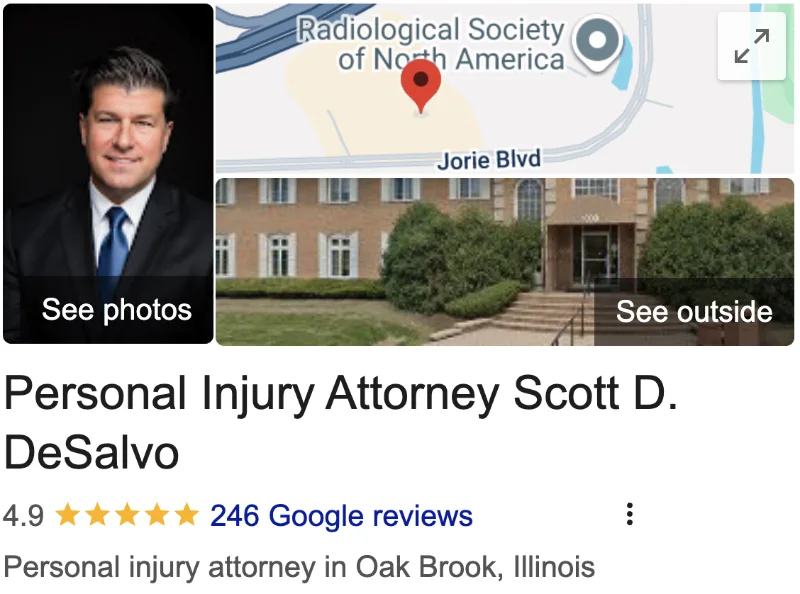
Scott DeSalvo founded DeSalvo Law to help injured people throughout Chicago and surrounding suburbs. Licensed to practice law in Illinois since 1998, IARDC #6244452, Scott has represented over 3,000 clients in personal injury, workers compensation, and accident cases.
No Fee Unless You Win | Free Consultation | 24/7 Availability Call or Text: (312) 500-4500
>>Read More
Main Office:
1000 Jorie Blvd Ste 204
Oak Brook, IL 60523
New Cases: 312-500-4500
Office: 312-895-0545
Fax: 866-629-1817
service@desalvolaw.com
Chicago and Other Suburban Offices
By Appointment Only