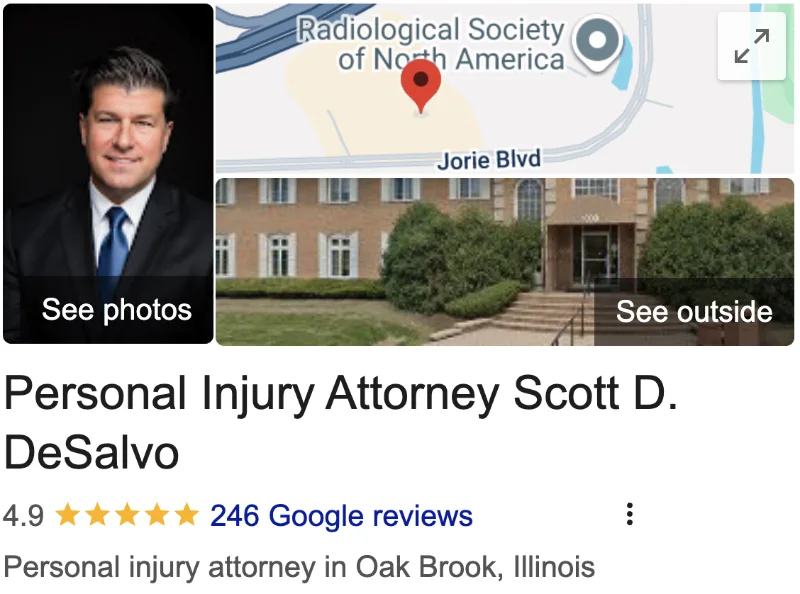


You went to work to earn a living. You did not go to work to be assaulted. And now you are carrying something that nobody at your job is willing to acknowledge, something the company may already be trying to bury. If you were sexually assaulted at your workplace in Chicago or anywhere in Illinois, what happened to you was not just a crime. It was a catastrophic failure by the people and the organization responsible for keeping you safe on the job.
I am Scott DeSalvo. For more than 27 years, I have represented working people in Illinois who have been harmed by the negligence and misconduct of others. I grew up watching my father, a truck driver and proud Teamster, spend 17 years trapped in a legal nightmare after a serious work injury. His lawyer abandoned him. The system ground him down. I became a trial lawyer specifically so that would never happen to someone on my watch.
Workplace sexual assault cases are different from anything else in personal injury law. They involve trauma that goes beyond physical injury. They involve employers who knew or should have known about dangerous people in their ranks and did nothing. They involve corporate lawyers who will try to silence you, discredit you, and make this go away quietly. You need an attorney who refuses to let that happen. That is the work I do, and I do not back down from it.
Reach me directly at 312-500-4500. Any hour. Any day. The conversation costs you nothing, it stays between us, and I will give you a straight answer about where you stand legally.

Most people lump sexual assault and sexual harassment together. The law does not. Understanding the difference is essential because the legal theories, the available claims, and the potential compensation are significantly different depending on which category your experience falls into.
Sexual harassment is a broad term that covers unwelcome conduct of a sexual nature in the workplace, ranging from offensive comments and inappropriate jokes to persistent unwanted advances. Under the Illinois Human Rights Act (775 ILCS 5/2-102) and federal Title VII, sexual harassment is treated as a form of employment discrimination. It is addressed through administrative complaints filed with the Illinois Department of Human Rights or the federal Equal Employment Opportunity Commission, and it carries specific filing deadlines and procedural requirements.
Sexual assault is something else entirely. It is physical. It is violent. It is a crime. Under Illinois criminal law (720 ILCS 5/11-1.20), criminal sexual assault involves sexual penetration by force or threat of force. Aggravated criminal sexual abuse (720 ILCS 5/11-1.60) covers other forced sexual contact. But here is the part that matters most for your civil case: when sexual assault happens in the workplace, you are not limited to an employment discrimination claim. You can bring a personal injury lawsuit. You can sue under the Illinois Gender Violence Act. You can pursue claims for negligent hiring, negligent retention, and negligent supervision against your employer. These civil claims carry no damage caps, allow for punitive damages, and do not require you to exhaust administrative remedies before filing suit.
That distinction opens doors that a harassment-only claim cannot. It means your employer’s exposure is not limited to back pay and reinstatement. It means we can pursue the full scope of compensation for the physical, emotional, and financial devastation that a sexual assault causes
Illinois gives survivors of workplace sexual assault more legal options than most people realize. You can pursue one, two, or all three of these paths simultaneously:
This is a standard civil lawsuit filed in the Circuit Court of Cook County or whichever county is appropriate. The claim targets the employer, not just the assailant. Under Illinois common law, an employer can be held liable for the intentional torts of its employees under theories of negligent hiring, negligent supervision, and negligent retention. The landmark Seventh Circuit decision in Anicich v. Home Depot (2017) confirmed that Illinois employers face tort liability when they negligently retain supervisors with known histories of sexual misconduct and fail to take reasonable steps after receiving complaints.
To succeed on a negligent hiring claim, you must show that the employer knew or should have known that the employee had a particular unfitness for the position that created a foreseeable danger. For negligent retention, you must show that after hiring, the employer learned of the employee’s dangerous propensities and failed to take appropriate action. For negligent supervision, you must show that the employer’s failure to adequately oversee or monitor employees contributed to the assault. These claims can yield substantial recoveries because they carry no statutory damage caps and allow for both compensatory and punitive damages.
The Illinois Gender Violence Act (740 ILCS 82) is a powerful and underutilized statute that creates a separate civil cause of action for victims of gender-related violence. It defines gender-related violence as any physical aggression or physical invasion of a sexual nature that satisfies the elements of battery under Illinois law, whether or not criminal charges were ever filed. The statute explicitly authorizes actual damages, emotional distress damages, punitive damages, and attorney’s fees.
The GVA carries a seven-year statute of limitations for acts of physical violence, far longer than the two-year filing deadline for employment discrimination charges under the IHRA. After the Illinois Appellate Court’s decision in Gasic v. Marquette Management (2019), employers can be held liable under the GVA for gender-related violence committed by their employees. The 2024 amendment to the GVA, effective January 1, 2024, further clarified employer liability and incorporated the IHRA’s definitions of employer and employee. This is a statute that many workplace assault lawyers overlook, and it can be the backbone of a devastating case against an employer.
The Illinois Human Rights Act imposes strict liability on employers for sexual harassment committed by supervisory employees. The Illinois Supreme Court held in Sangamon County Sheriff’s Department v. Illinois Human Rights Commission (2009) that an employer is strictly liable for a supervisor’s sexual harassment regardless of whether the employee suffered a tangible employment action and regardless of whether the supervisor had direct authority over the victim’s employment terms. Illinois is more protective than federal law in this regard. Under Title VII, employers may assert an affirmative defense to vicarious liability in certain circumstances. Under the IHRA, no such defense exists for supervisory harassment.
For harassment by co-workers or non-employees, the IHRA imposes liability on a negligence standard: the employer is responsible if it became aware of the conduct and failed to take reasonable corrective measures. Employment discrimination charges must be filed with the Illinois Department of Human Rights within two years of the most recent incident. This route can provide compensation and injunctive relief, but the recovery potential is generally more limited than what is available through a personal injury lawsuit or a GVA claim.
In a workplace sexual assault case, the employer’s liability almost always comes down to one central question: what did the company know, and when did it know it? The more evidence that management was aware of a danger and failed to act, the stronger the case becomes. These are the patterns of employer failure that I encounter most frequently:
The most common and most damaging failure. An employee files a complaint about a co-worker’s aggressive or sexually inappropriate behavior. Management receives the complaint, maybe even documents it, and then does absolutely nothing. Or management conducts a cursory “investigation” that amounts to asking the accused person if they did it, accepting their denial, and closing the file. When the same person later escalates to physical assault, every ignored complaint becomes evidence of the employer’s conscious disregard for employee safety.
Illinois law requires employers to exercise reasonable care in hiring. When an employer hires someone for a position that involves access to vulnerable employees, customers, or clients, and fails to conduct a reasonable background investigation, the employer may be liable for any foreseeable harm that results. This is especially relevant in industries like healthcare, hospitality, home services, and transportation, where employees routinely have unsupervised access to others.
An employer who discovers that an employee has engaged in sexual misconduct and allows that person to remain in the same position, with the same access to potential victims, has made a deliberate choice. That choice exposes the employer to liability for every subsequent act of misconduct by that employee. In the landmark $95 million federal verdict in Ashley Alford’s case against Aaron’s Inc. in East St. Louis, Illinois, the jury found that the company ignored multiple complaints about a store manager’s sexual assaults on a subordinate, awarding $50 million in punitive damages for sexual harassment and $30 million in punitive damages for negligent supervision.
Some workplaces are structured in ways that make employees vulnerable. Late-night shifts with minimal staffing. Isolated work locations. Environments where one person holds unchecked authority over another. Employers have a duty to identify foreseeable risks and implement reasonable safeguards. When they fail to do so, and an assault occurs in the vacuum of that failure, the employer shares responsibility.
Retaliation is both a separate legal violation and powerful evidence of the employer’s mindset. When an employer fires, demotes, transfers, or otherwise punishes an employee for reporting sexual assault, it demonstrates that the company prioritizes self-protection over employee safety. Under both the IHRA and Title VII, retaliation against an employee who reports sexual misconduct is independently actionable. Under the IHRA, even non-employees who report sexual harassment are protected from retaliation.


Workplace sexual assault happens across every industry, but certain sectors see disproportionately high rates. Understanding the dynamics of these industries helps explain why assaults occur and why employers are often liable:
The restaurant and hospitality industry has one of the highest rates of workplace sexual misconduct in the country. Power imbalances between management and service staff, tipped wage structures that make employees economically dependent on supervisors, late-night hours, alcohol-fueled environments, and a culture that often normalizes inappropriate behavior all contribute. Illinois requires restaurants and bars to provide supplemental sexual harassment training under Section 2-110 of the IHRA, recognizing the heightened risks in this sector.
Healthcare facilities, including hospitals, clinics, and home health agencies, present unique dangers because of the physical nature of patient care and the hierarchical authority structures within medical settings. Nurses, medical assistants, home health aides, and other frontline workers are disproportionately affected. The power differential between physicians and support staff can create environments where misconduct goes unreported.
The transportation and rideshare industry exposes drivers and passengers to isolated, one-on-one situations with little oversight. Manufacturing, warehouse, and construction environments often feature predominantly male workforces, isolated work areas, and supervisory structures that concentrate authority in individual foremen or managers. Domestic workers, including housekeepers and nannies, are particularly vulnerable because they work in private homes with little visibility or institutional oversight.

Different legal claims carry different statutes of limitations, and missing a deadline can eliminate your right to recover compensation entirely:
For a personal injury negligence claim in Illinois, the general statute of limitations is two years from the date of the assault under 735 ILCS 5/13-202. If the assault was not immediately discovered, the discovery rule may extend this deadline to two years from the date you knew or should have known of the injury.
For a claim under the Illinois Gender Violence Act, you have seven years from the date of the assault to file suit. This significantly longer window makes the GVA particularly valuable for survivors who were not ready to come forward immediately.
For an employment discrimination charge under the IHRA, you must file with the Illinois Department of Human Rights within two years of the most recent discriminatory act. Under federal Title VII, you must file with the EEOC within 300 days.
For workers’ compensation benefits related to psychological injuries caused by workplace assault, the filing deadline is generally three years from the date of the incident under 820 ILCS 305/6(d).
These deadlines overlap and interact in complex ways. One of the most important things a lawyer does in a workplace sexual assault case is identify every viable claim and ensure that no filing deadline is missed. The sooner I am involved, the better I can protect the full range of your legal options.
Find Out What YOUR Case Might Be Worth...for free.
I have represented enough survivors to know that calling a lawyer is one of the hardest steps in this process. There are real reasons why people wait, and none of those reasons diminish the validity of what happened to you.
Many survivors fear retaliation. They worry about losing their job, being blacklisted in their industry, or being labeled a troublemaker. Illinois law explicitly prohibits retaliation for reporting sexual misconduct, and violations of the anti-retaliation provisions are independently actionable. But the fear is real, and I understand it.
Some survivors blame themselves or question whether what happened was “bad enough” to warrant legal action. Let me be direct about this: if someone at your workplace touched you sexually without your consent, that is assault. It does not matter whether you fought back. It does not matter whether you froze. It does not matter whether you had a prior relationship with the person. Non-consensual sexual contact is assault, and you are entitled to hold the responsible parties accountable.
Others worry about privacy. They do not want their names in the news or their personal lives scrutinized. Civil lawsuits can often be filed using pseudonyms such as “Jane Doe” or “John Doe,” and I work to protect my clients’ privacy at every stage of the process. Many workplace sexual assault cases resolve through confidential settlements that are never made public.
My background is not in employment law. It is in personal injury litigation. That distinction matters because I approach workplace sexual assault the way I approach every catastrophic injury case: as a trial lawyer preparing to put a company on trial for the harm it caused.
Employment lawyers often default to filing administrative charges and negotiating severance packages. There is a time and place for that approach. But when you have been physically assaulted at work, and the company’s negligence enabled it, the case deserves more than an EEOC complaint. It deserves a full civil lawsuit with discovery, depositions, expert testimony, and the credible threat of a jury trial.
I have tried more than 30 cases to a jury. I graduated from Gerry Spence’s Trial Lawyer’s College in Wyoming, a program that accepts fewer than one in 10,000 practicing lawyers. I completed “The Edge,” an advanced course for seasoned trial attorneys. When the company’s lawyers see that I am on the other side, they know the case is not going to be quietly resolved for nuisance value. They know I will take it to a courtroom if that is what it takes.
I also bring something that very few personal injury attorneys in Chicago have: formal training in trauma-informed interviewing. When I sit down with a survivor, I know how to have that conversation in a way that is respectful, careful, and focused on building a strong case without causing additional harm. That skill makes a difference in every phase of the case, from the initial consultation through trial testimony.
Mi oficina también ofrece servicios bilingües en español. For Spanish-speaking workers who have been assaulted on the job, language should never be an obstacle to justice.

Yes. Your employer can be liable under theories of negligent hiring, negligent supervision, and negligent retention if it knew or should have known about the co-worker's dangerous propensities and failed to take appropriate action. Under the Illinois Gender Violence Act, 740 ILCS 82, employers can also face direct liability for gender-related violence committed by their employees. The civil case is about what the company failed to do, not just what the individual did.
No. A civil lawsuit is completely independent of the criminal justice system. You can file a civil claim regardless of whether you reported the assault to police, regardless of whether criminal charges were filed, and regardless of the outcome of any criminal case. Many survivors choose to pursue civil claims without ever involving law enforcement, and that is entirely within their rights.
You may still have legal options. The statute of limitations for a personal injury negligence claim is two years under 735 ILCS 5/13-202. Under the Illinois Gender Violence Act, you have seven years. For childhood sexual abuse, Illinois has no statute of limitations for abuse occurring on or after January 1, 2014, and a 20-year discovery rule for pre-2014 abuse under 735 ILCS 5/13-202.2. Even if one deadline has passed, another may still be open. I evaluate the full timeline during every initial consultation to determine which claims remain viable.
An employer's internal reporting procedures do not define your legal rights. While following the employer's complaint process can strengthen certain claims, your failure to use the exact procedure outlined in an employee handbook does not prevent you from filing a civil lawsuit or a charge of discrimination. Illinois law imposes obligations on employers to prevent assault, not on employees to navigate bureaucratic reporting trees while dealing with trauma.
Illinois law prohibits retaliation against employees who report sexual misconduct or file legal claims. If your employer fires, demotes, or otherwise punishes you for asserting your rights, the retaliation itself becomes an additional legal claim with its own damages. That said, I understand the practical concern. We can discuss strategies to protect your employment and your case during our initial consultation.
Compensation in a workplace sexual assault case can include past and future medical and psychological treatment, lost wages and lost earning capacity, pain and suffering, emotional distress, and loss of normal life. Under the Illinois Gender Violence Act, attorney's fees and punitive damages are explicitly authorized. In cases involving institutional cover-ups or particularly egregious employer failures, punitive damages may also be available under common law. Every case is different and the value of any individual case depends on the specific facts, the severity of the assault, the documented impact on the survivor, and the degree of employer fault.
Nothing upfront. Nothing out of pocket. I handle workplace sexual assault cases on a contingency fee, meaning my compensation comes exclusively from the recovery we obtain for you. If there is no recovery, you owe me nothing. I invest my own resources into building your case because I only take cases I believe in.
I combine personal injury trial experience with trauma-informed client care. When you reach out to my office, you speak with me directly, not an intake coordinator or a paralegal screening calls. I have personally handled over 3,000 injury cases across almost 30 years of practice. I prepare every case as if it is going to trial, and the companies I go up against know that. My office serves both English and Spanish-speaking clients, and I remain personally involved in every case from the first phone call to the final resolution.


You do not have to carry this alone, and you do not have to figure out the legal system by yourself. Pick up the phone and call 312-500-4500. Tell me what happened. I will listen, and I will be honest with you about whether your situation warrants a case and what I believe it could be worth. The consultation is free. The conversation is confidential. And if we move forward together, you will never receive a bill from me unless we win.
The company that let this happen to you has already hired lawyers. They are already building a defense. Every day that passes without a lawyer on your side is a day they use to their advantage. Evidence disappears. Witnesses forget. Surveillance footage gets overwritten. Internal emails get deleted. Time is not neutral in these cases. It favors the people who act first.
I have spent my entire career standing up for working people who were failed by the very institutions that were supposed to protect them. If that is what happened to you, I am ready to go to work.
>>Back To Main Page <<


Scott DeSalvo founded DeSalvo Law to help injured people throughout Chicago and surrounding suburbs. Licensed to practice law in Illinois since 1998, IARDC #6244452, Scott has represented over 3,000 clients in personal injury, workers compensation, and accident cases.
No Fee Unless You Win | Free Consultation | 24/7 Availability Call or Text: (312) 500-4500
>>Read More
Main Office:
1000 Jorie Blvd Ste 204
Oak Brook, IL 60523
New Cases: 312-500-4500
Office: 312-895-0545
Fax: 866-629-1817
service@desalvolaw.com
Chicago and Other Suburban Offices
By Appointment Only