

Brookfield is a small residential village that hosts an enormous crowd, and that combination is exactly what makes injuries here different from most suburbs. Around two million people a year pass through the gates of Brookfield Zoo at 8000 W 31st Street, and to reach it they pour down Ogden Avenue, crowd the intersection of First Avenue and 31st Street, fill the parking lots, and ride the Metra BNSF line into the Hollywood/Zoo, Brookfield, and Congress Park stations. Layer that seasonal flood of out-of-town visitors on top of the ordinary life of a working village — kids walking to school, commuters, delivery trucks, families running errands along Washington Avenue — and you get a place where the sheer volume of people multiplies the number of ways a person can be hurt. And when it happens, the party on the other side is frequently not a neighbor but a large operator, a corporate landowner, an insurance company, or a government body, each with lawyers whose job is to pay you as little as possible.
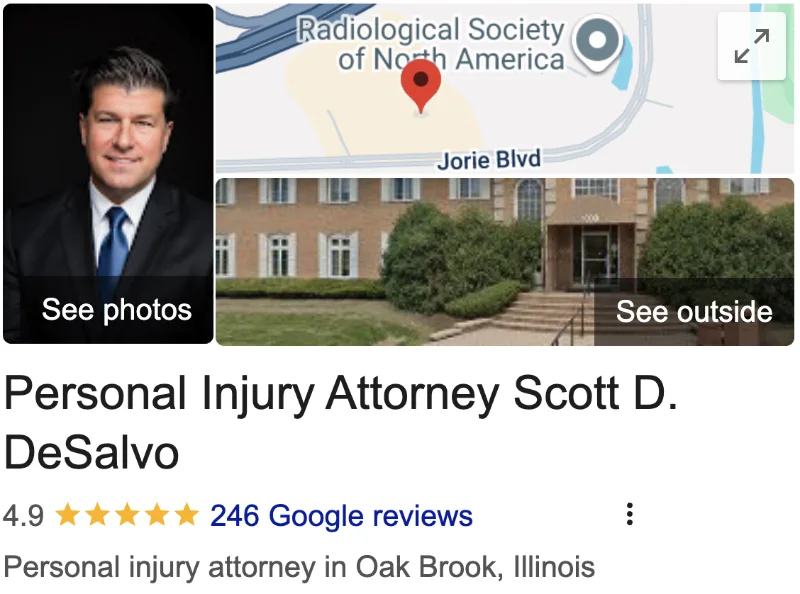
My name is Scott DeSalvo, and for almost 30 years I have represented injured people across Cook County and the suburbs like Brookfield. I am not a volume, assembly-line firm that runs a thin webpage for every town and treats every claim like a file number. I deliberately take a limited number of cases so that each client gets real attention from the lawyer whose name is on the door. If you were hurt in Brookfield — as a resident or as one of the millions who came to visit — you can reach me 24 hours a day at 312-500-4500, and the call is free.
A town built around a two-million-visitor attraction generates injury patterns you simply do not see in a quiet bedroom suburb. The crowds mean crowded crosswalks and crowded parking lots. The out-of-town traffic means drivers who do not know that Ogden Avenue is US-34, a genuinely busy commercial highway, or that families stream across 31st Street near the zoo entrance. The event-and-hospitality economy around a major attraction means seasonal and part-time workers, temporary staff, food vendors, and maintenance crews — the very workers most likely to be told, wrongly, that they are not covered when they get hurt. And large venues and commercial properties carry the kind of formal incident-reporting and video systems that can either prove your case or quietly disappear.
All of that points to one conclusion: the defendant in a Brookfield case is often big, well-funded, and well-defended. That is not a reason to walk away. It is a reason to have a lawyer who is genuinely prepared to fight, because a large operator's insurer pays fairly only when it believes the person across the table will take the case all the way if it has to.

I am a graduate of both Gerry Spence's Trial Lawyers College and the Keenan Trial Institute, and that training is not a decoration — it changes what your case is worth. The overwhelming majority of injury cases settle, and most of mine do too. But they settle for more because the insurer knows I prepare every file as though it is going to a jury. Adjusters keep score. When the lawyer on the other side is known to fold, the offers are low. When the lawyer is known to try cases, the offers move.
That trial-ready posture matters even more when the defendant is a corporation or a public entity. These are the parties that count on you being overwhelmed, unrepresented, and eager to make the problem go away for a fraction of its value. Preparing the case seriously from day one is how you take that leverage back.
Illinois law lets an injured person recover far more than a stack of medical bills, and knowing the full list is part of getting paid fairly. The categories include past and future medical expenses, lost income and lost earning capacity, physical pain, disability and disfigurement, and the loss of a normal life — the things you can no longer do the way you used to. Insurers love to talk only about bills already paid, because that number is the smallest. A real evaluation of your claim accounts for the future, not just the receipts already in the folder.
In Illinois you generally have two years from the date of injury to bring a personal injury claim, but the exceptions are the traps. Workers' compensation allows three years, yet usually requires notice to the employer within 45 days. Medical malpractice runs two years from discovery with a hard four-year ceiling, and children are governed by separate rules. And a claim against a government body — think a village sidewalk, a park district lot, a public vehicle — can be dramatically shorter, sometimes about a year, with special notice requirements. In a town where the county courts sit at the Maywood courthouse (the Fourth Municipal District), and where public property and public agencies are everywhere, those short government deadlines come up more than people expect. Calling early is how you keep every option open.
Two worries stop injured workers from calling a lawyer, and both are misplaced. First, the cost: in Illinois, a workers' comp attorney's fee is capped by law at 20% of the recovery — you pay nothing up front, and studies consistently show represented workers net more even after the fee. Second, the fear of getting fired: it's illegal in Illinois to fire or retaliate against you for filing a legitimate claim, and if it happens, you have a separate case for it.
Bottom line: comp is a right you earned, not a favor — and the deadline to protect it (three years, with that 45-day notice) starts running the day you're hurt.
Ogden Avenue, 31st Street, and the zoo-area intersections put drivers, pedestrians, and cyclists together in heavy volume, and crashes here are common. From rear-end collisions in stop-and-go highway traffic to pedestrians and bicyclists struck in crosswalks, I handle the full range — including cases against commercial trucking companies, whose logs, maintenance records, and corporate liability demand fast, knowledgeable action.
The seasonal, hospitality, event, and outdoor jobs clustered around a major attraction produce a steady stream of on-the-job injuries. Illinois workers' compensation should cover your medical care and lost wages, and I fight the denials, the misclassification games, and the pressure to return before you are ready.
Big venues and busy stores that host large crowds also create the conditions for slip-and-fall and trip-and-fall injuries. When a property owner fails to fix or warn about a hazard, I hold them accountable — and I move quickly to preserve the surveillance video and incident reports that decide these cases.
When a hospital, doctor, or OB provider falls below the accepted standard of care and causes real harm, Illinois law provides a remedy. These cases are expensive and hard, they require a qualified physician's review before filing, and I take them on when the evidence supports it.
Chronic understaffing in nursing homes is the root cause behind bedsores, falls, dehydration, and missed care. Under the Illinois Nursing Home Care Act, residents and families have real rights and a private right of action, and the records usually tell the story.
When negligence takes a life, Illinois lets the family pursue a wrongful death claim for their loss and a survival claim for what their loved one endured. I handle these with the seriousness and care such a loss demands.
"Scott is absolutely fantastic. He will always go the extra mile for his clients. They always take the time to return phone calls at all hours and I highly recommend him to all my friends."
-Melissa Brooks
"Great people and Scott's a great lawyer. They helped me make the wisest decision for my case, and that's important in serious legal matters. I trust him completely. He is the one to call."
-Tony Skvarenina
"Beyond satisfied with the services I received from this law firm. Definitely recommend! They got me fully paid and all the doctor bills, too. If you want the best, this is the law firm for your injury case!"
-Cynthia Rodriguez
"Scott represented me and I was really pleased with everything, my car accident paid a lot and quick. If you want a good Lawyer who is responsive, and straight with you, I highly recommend him."
-Greg Garcia
If you've fully recovered and no insurer is involved, maybe not. But if you missed work, needed ongoing care, or an insurance company is in the picture, a free call before you accept anything is worth your time. Insurers often treat suburb claims as easy wins, betting that you'll assume you don't need help — and that assumption is what costs people.
Most personal injury claims give you two years from the injury. Workers' comp allows three years but usually requires notifying your employer within 45 days, and medical malpractice has its own two-year and four-year limits. Claims against a government body can be much shorter. Since the exceptions are easy to miss, ask early.
Nothing up front, and nothing unless I win. I work on contingency, so my fee comes only from money I recover, and I advance the case costs myself. If there's no recovery, you owe nothing.
Because local knowledge and real attention change outcomes. A firm running a thin page about your town often won't know its roads, its hazards, or the Cook County courts — and it may handle cases in volume. I take fewer cases and know this county, which is what your claim actually needs.
Almost certainly not — the vast majority settle. But settling well depends on the insurer believing your lawyer is prepared to go to court if they lowball you. That readiness is what produces a fair settlement without a trial.
As soon as you reasonably can. Evidence disappears, records get overwritten, and deadlines run. An early call doesn't commit you to anything — it simply keeps your options open while everything is fresh.

Scott DeSalvo founded DeSalvo Law to help injured people throughout Chicago and surrounding suburbs. Licensed to practice law in Illinois since 1998, IARDC #6244452, Scott has represented over 3,000 clients in personal injury, workers compensation, and accident cases.
No Fee Unless You Win | Free Consultation | 24/7 Availability Call or Text: (312) 500-4500
>>Read More
Main Office:
1000 Jorie Blvd Ste 204
Oak Brook, IL 60523
New Cases: 312-500-4500
Office: 312-895-0545
Fax: 866-629-1817
service@desalvolaw.com
Chicago and Other Suburban Offices
By Appointment Only