
If you've never been through a workers' comp case before, the whole process can feel overwhelming. There are filings, hearings, medical evaluations, and a ton of terminology that nobody explains. So let me walk you through what an Illinois workers' compensation case actually looks like from start to finish.
It starts the moment you get hurt at work. You report the injury to your employer (within 45 days is the legal requirement, but sooner is always better). Your employer files a report with their workers' comp insurance carrier. The insurance carrier either accepts or disputes your claim. If they accept, they start paying your medical bills and temporary disability benefits. If they dispute, that's when the fight begins.
When a claim is disputed, we file an Application for Adjustment of Claim with the Illinois Workers' Compensation Commission (IWCC). This officially opens your case in the system. From there, we go through a period of discovery where both sides gather evidence — your medical records, employment records, and sometimes depositions of witnesses.
One of the most important steps in a workers' comp case is the Independent Medical Examination, or IME. The insurance company will send you to a doctor of their choosing to evaluate your condition. Make no mistake: this doctor is being paid by the insurance company, and their job is to minimize your injuries. That doesn't mean you can skip the IME — you're required to go. But you should be honest, don't exaggerate, and tell your lawyer exactly what happened at the exam so we can challenge the IME report if it's inaccurate.
Eventually, most cases reach a point where both sides are ready to discuss settlement. In workers' comp, there are two types of settlements: a lump sum settlement (called a Section 8(j)(1) settlement) where you receive one payment and close the case, or a wage differential award if you can still work but at a lower wage. The type of settlement depends on the nature of your injuries and your work situation.
Every workers' comp case is different, but the general timeline from injury to settlement is usually 12 to 24 months. Some complex cases take longer. If you've been hurt at work in Illinois and want someone to guide you through this process, call us at 312-500-4500.
Find Out What YOUR Case Might Be Worth...for free.
In Workers' Comp, we call it "Average Weekly Wage" (AWW). Basically, it is your wages you make in an average week. We use the total number, not the take-home pay. The gross pay, not the net pay.
Why is it important?
All of your benefits in an Illinois Workers Compensation case come down to how much money you make. That's because how much your get paid while off work (TTD - Temporary Total Disability) and how much settlement money you get at the end of the case (PPD - Permanent Partial Disability) is calculated by using your Average Weekly Wage.
Example:
Let's say you work 40 hours per week and you make $25 per hour. That means in an average week, you make $1,000.
Your TTD Rate would be $1,000 x 2/3 (or 662/3%) = $733.33. That is what you would get every week you were off work with a doctor's note.
Your PPD Rate would usually be 60%. So $1,000 x .60 (or 60%) = $600.00. This number is used to calculate what you get at the end of your Illinois Workers Comp case.
So the way it works out is, the more money you make per week, the more money you get while off work, and the bigger the settlement at the end of the case. Keep in mind, though, that there are State maximum and minimum TTD and PPD rates. This is great for lower-wage earners but it cuts off the Illinois Workers Compensation case value for high-wage earners.
Also note that if you are completely and totally unable to work due to your on-the-job injury, then the Permanent Total Disability (PTD) rate is 2/3 or 66 2/3%.
How bad your injury is will determine how much medical care you are likely to be able to get without a dispute arising. When a case is being paid with no hassle or argument, we call it an "accepted case".
Oftentimes, a client will hire me, and as soon as I am on the case, I am able to get payments and benefits going. Or if they are already being paid, they stay good. And this way, if any problems arsie, the injured worker can call me, and I can sort out the problem with their Illinois Workers Compensation case benefits quickly.
But when a case is disputed, it means that the Workers' Comp insurance wants to fight the case. That means they can refuse to pay for your time off work or your medical bills. They will also usually not want to pay a settlement (PPD) at the end of the case. This is when having a lawyer on your side is very important.
The seriousness of your injury will determine how much medical care you can get, as well as how long a doctor is likely to give you an off-work note. But the true importance of the seriousness of the injury comes in calculating your settlement at the end of the case.


In a work injury case where you recover and can go back to your old job, we look at your medical records. We need to know how serious your injury is. We want to know what the treatment was, and what your ongoing complaints are.
Then, we look up similar cases in a book or a computer databases. These are kept by companies that support the efforts of law firms that handle work injury cases. There is usually a monthly or yearly fee to get access to these books.
You find similar cases. Same treatment. Same body part. Same surgery. By doing that, you come up with a percentage range of loss of use of the body part.
For example, a particular injury might have been settled in the past somewhere between 5% of a leg and 10% of a leg, from looking up similar cases.
The Illinois Workers Compensation case law says that 5% loss of use of a leg is 10.75 weeks of work, and 10% of a leg is 21.5 weeks.
10.75 weeks x your PPD rate of $600.00 = $6,450.00.
21.5 weeks x $600.00 = $12,900.00
So in our example, your case would settle somewhere in between $6,450.00 and $12,900.00. But your medical bills and time off work would also be paid in addition or separately.
Keep in mind that this is an example. In a real case, I always start high and make them work me down to a lower range. My job is to get injured people as I can. Not to save insurance companies money.
Also, keep in mind that Workers' Comp allows for payments of many other kinds of benefits. That will depend on your situation and your injury. Even in a small injury, a good Workers Comp lawyer can get you all the benefits you deserve. And that sometimes means benefits you didn't even know you could ask for.
Find out if you have a good case, or a tough one...for free!
As we talked about above, if you cannot return to work, then you do not use the PPD rate. Instead, you use the PTD (Permanent Total Disability) rate. Again, that is 2/3 of your weekly salary, not 60% as in PPD.
If you are found to be permanently and Totally Disabled, then you receive benefits of the PTD payments for life. Keep in mind that there is a statutory maximum rate. It goes up every year. For the yer 2021, for example, the maximum rate is $1,210.45.
If you are not able to return to your old job, you may still be able to be retrained to do a different one. Vocational assessment and rehabilitation, and job training are benefits that are all possible in an Illinois Workers' Compensation case. Again, it depends on your situation.
Keep in mind that you have 45 days from the date of your work injury to report your Illinois Workers' Compensation case injury.
You have 3 years from the date of your injury to file the case at the Workers' Compensation Commission.
I always repeat these deadlines so no one misses one. If you have a lawyer, they will help with these, so you do not have to remember them.

Illinois workers comp settlement value is driven primarily by three factors: your average weekly wage before the injury, the body part injured, and the permanency rating - expressed as a percentage of loss of use of that body part. The Illinois Workers' Compensation Act assigns specific values to different body parts. A higher permanency rating multiplied by a higher wage produces a larger settlement. Getting the permanency rating right - through your treating physician's opinion - is the single most important factor in maximizing your case value.
The whole person has the highest value, which is used for injuries that affect overall function - spinal injuries, brain injuries, and other conditions that don't map to a single body part. Major extremities like arms and legs have substantial statutory values. Hands, feet, eyes, and ears have their own specific values. The spine is evaluated as a percentage of loss of use of the whole person for most purposes. I know the statutory values and how to position your injury for maximum permanency recovery.
Generally no - full and final settlements are binding and cannot be reopened even if your condition deteriorates. This is why settling only after reaching true MMI, and getting the permanency rating right before settling, is so critical. Open awards - which keep future medical benefits open without fully closing the disability claim - provide more flexibility but have their own tradeoffs. I explain both options in plain language and help you decide which is right for your situation.
Yes - consistently. Workers who are represented recover more in Illinois workers comp cases than those without attorneys, even after deducting the 20% fee. The reasons: attorneys know the permanency rating system, challenge lowball IME opinions, know when to push to arbitration versus settle, and ensure all benefits - medical, TTD, permanency - are maximized. The cost of going unrepresented is almost always higher than the 20% attorney fee. Call 312-500-4500 for a free evaluation.
Illinois law requires you to notify your employer of a work injury within 45 days of the date of the accident. Missing this deadline is one of the most common ways injured workers lose their claims before they even get started. Notice should be in writing whenever possible, signed, and dated. Verbal notice can be enough but it is much harder to prove later. There is a separate three-year deadline to file the case at the Illinois Workers' Compensation Commission, but the 45-day notice is the early trap. Report the injury the day it happens if you can.
An accepted case is one where the insurance carrier admits the injury is work-related and starts paying TTD checks and medical bills without a fight. A disputed case is one where the carrier denies the claim is work-related, denies that the medical treatment is reasonable and necessary, or otherwise refuses to pay. Disputed cases require filing an Application for Adjustment of Claim with the IWCC and litigating. Even accepted cases can become disputed mid-stream - for example, when the carrier suspends benefits based on an IME. Either way, having a lawyer matters.
Permanent Total Disability applies when your work injury leaves you completely unable to return to any kind of gainful employment - not just your old job. PTD pays at two-thirds of your average weekly wage (rather than 60 percent for PPD), and the benefits continue for life rather than a fixed number of weeks. There is an annual statutory maximum rate that adjusts each year. PTD eligibility is hard-fought - the insurance company will push back hard against any PTD claim. Vocational rehabilitation evidence is often the key to winning a PTD case.
Most Illinois workers' comp cases resolve within 12 to 24 months from the date of injury. Some are quicker - especially accepted cases with straightforward injuries that heal predictably. Complex cases involving disputed causation, multiple body parts, surgery, or PTD claims can run longer. The timeline is driven by how long it takes you to reach maximum medical improvement (MMI), because we cannot settle the permanency portion of the case until your doctors say you are as recovered as you are going to get. Rushing to settle before MMI almost always leaves money on the table.
Would you like to know more about workers' comp lawyer chicago?
If you or a loved one is dealing with a situation like this, give us a call any time, day or night.We are here to help. 312-500-4500


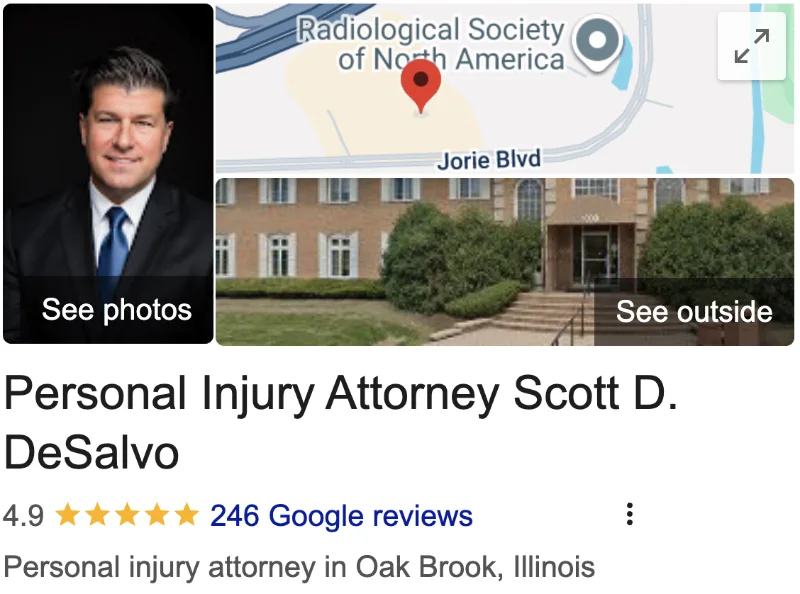
Scott DeSalvo founded DeSalvo Law to help injured people throughout Chicago and surrounding suburbs. Licensed to practice law in Illinois since 1998, IARDC #6244452, Scott has represented over 3,000 clients in personal injury, workers compensation, and accident cases.
No Fee Unless You Win | Free Consultation | 24/7 Availability Call or Text: (312) 500-4500
>>Read More
Main Office:
1000 Jorie Blvd Ste 204
Oak Brook, IL 60523
New Cases: 312-500-4500
Office: 312-895-0545
Fax: 866-629-1817
service@desalvolaw.com
Chicago and Other Suburban Offices
By Appointment Only