

In a town full of hotels, offices, and restaurants, a fall usually happens on property owned by one company, leased by another, cleaned by a third, and insured by someone none of them will name to you. That tangle isn't an accident — it's what lets each business point at the others while you're left holding a real injury and a stack of bills. Cutting through it to find who's actually responsible is where these cases are won.
I'm Scott DeSalvo, and premises cases have been part of my DuPage County practice for almost 30 years. If you fell in an Itasca hotel lobby, an office building near Hamilton Lakes, a restaurant, or a parking lot off Irving Park Road, here's how these cases really work — and the consultation is free.
The responsible party is rarely obvious, especially in Itasca's commercial buildings. Depending on where you fell, it could be the business that occupied the space, the company that owns the property, a separate management firm, a janitorial contractor hired to keep floors safe, or a snow-removal company that cut corners. Each carries its own insurer, and each will happily blame the others — and you.
Picture a fall on a slick hotel lobby floor where tracked-in water kept pooling and no mat was down. The hotel blames its cleaning contractor, the contractor blames the property owner's leaky entrance, and all of them blame you for not looking. Untangling that — and making sure someone answers for it — is the work.

Here's the rule that governs every fall claim in Illinois: an owner isn't automatically responsible just because you got hurt on their property. You have to show they knew, or reasonably should have known, about the danger and failed to fix it or warn you. Lawyers call it notice.
That's why the timeline is everything. How long was that spill on the floor before you hit it? Was there a pattern of the same hazard? Did a camera capture how long it sat? Those answers live in evidence that gets recorded over, thrown out, or "lost" within days. Move quickly and it still exists; wait, and it becomes your word against a business that has had time to clean up and prepare its story.
If you fell on ice, Illinois has a rule worth knowing: under the natural accumulation doctrine, an owner generally isn't liable for ice that formed naturally from the weather. But if the owner made it worse — plowing snow into a pile that refroze across a walkway, letting a downspout drain onto a sidewalk, or leaving a low spot that traps and freezes water — that unnatural accumulation can be a claim. Most people assume any icy fall is the owner's fault; it isn't, and that distinction is exactly what a premises insurer will use to deny you.
Premises insurers run two plays. First, they blame you: if they can pin more than half the fault on you for not watching your step, Illinois law lets you recover nothing — so they'll call the hazard "open and obvious." Second, they minimize the injury, digging through your history for any old complaint to say the fall changed nothing. Fall cases are genuinely harder than car cases because of those defenses, which is all the more reason to have someone who knows how to get around them.
Bottom line: "I just slipped" often becomes the most disruptive injury of someone's life — treat it, document it, and don't let an insurer shrug it off.
The evidence is disappearing as we speak, so don't wait. Call me, tell me where and how you fell, and I'll give you an honest read on whether the notice and fault picture supports a case. If it does, we move immediately to lock down the proof. It's free, and you pay nothing unless I win for you.
I'm available any time, day or night. Call 312-500-4500.

Falls are just one kind of injury I handle. For everything else, see my Itasca Personal Injury Attorney page.
Generally two years from the date of your fall against a private business or owner. But a fall on public or government property — a village sidewalk, a park district lot, a public building — can carry special notice rules and much shorter deadlines, sometimes about a year. Those government deadlines are easy to blow, so call as soon as you can.
That's exactly the question these cases turn on, and it may be more than one. The occupying business, the property owner, a management company, and a maintenance or snow contractor can all share responsibility, each with its own insurer. Part of my job is identifying every party whose carelessness contributed and pursuing each one that's liable.
Possibly — the answer turns on whether the ice was natural or man-made. Illinois usually doesn't hold owners responsible for naturally accumulated ice, but if they created the hazard — refrozen plow piles, a draining downspout, or defective pavement — you may have a strong claim. It's a technical line, and it's the one the insurer will fight on, so it helps to have someone who can prove an unnatural accumulation.
Not necessarily. Illinois uses modified comparative negligence, so being partly at fault doesn't end your claim as long as you weren't more than half responsible — your recovery is just reduced by your share. Insurers always push to get you over that line with the "open and obvious" argument, and pushing back is a big part of what I do.
Nothing out of pocket. I take these on contingency — my fee comes only from what I recover for you, and if there's no recovery, you owe nothing. I also front the investigation costs, like securing camera footage and expert analysis. You never pay me to get started.


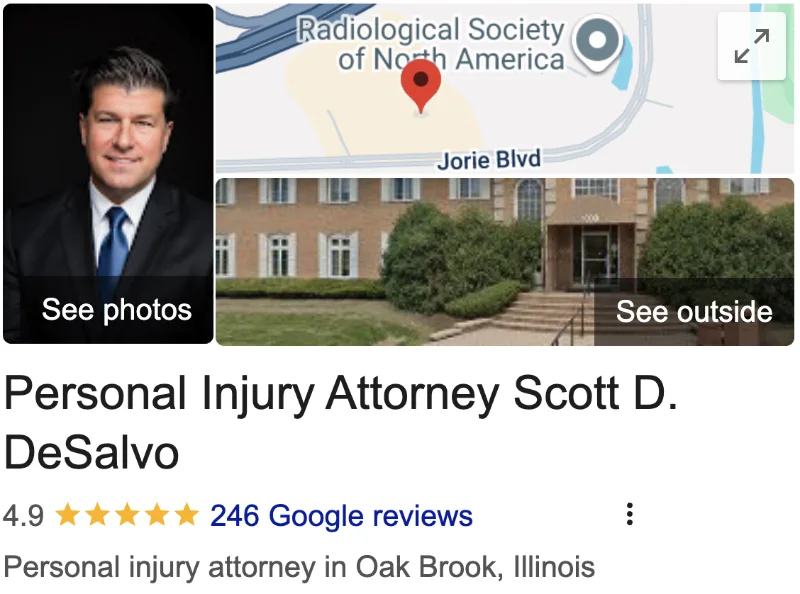
Scott DeSalvo founded DeSalvo Law to help injured people throughout Chicago and surrounding suburbs. Licensed to practice law in Illinois since 1998, IARDC #6244452, Scott has represented over 3,000 clients in personal injury, workers compensation, and accident cases.
No Fee Unless You Win | Free Consultation | 24/7 Availability Call or Text: (312) 500-4500
>>Read More
Main Office:
1000 Jorie Blvd Ste 204
Oak Brook, IL 60523
New Cases: 312-500-4500
Office: 312-895-0545
Fax: 866-629-1817
service@desalvolaw.com
Chicago and Other Suburban Offices
By Appointment Only