
The insurance check that arrives fastest is almost never the one that's fair. After a crash, the at-fault driver's insurer wants to close your claim while you're still rattled and before anyone knows how badly you're actually hurt — because an early settlement is a cheap settlement. That's the whole game, and most people don't find out until it's too late to undo.
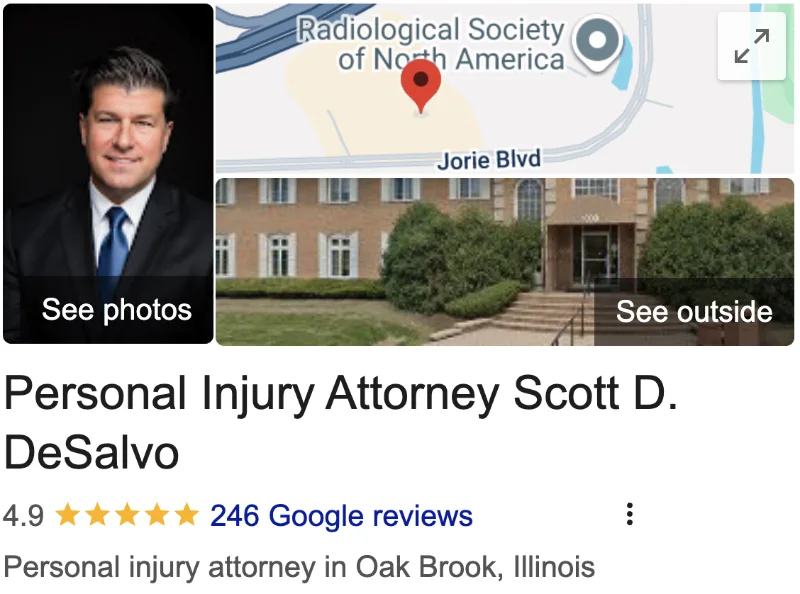
I'm Scott DeSalvo, and for almost 30 years I've handled crash cases across DuPage County. Whether you were hit on I-88, at a Route 53 intersection, or on Ogden Avenue here in Lisle, my job is to slow that process down, get the full picture of your injuries on the record, and make the insurance company pay what the case is really worth. The first conversation is free.
Speed is the dividing line. On I-88 and Route 53, crashes happen at highway speed, and the injuries tend to be severe — the kind that need surgery, months of rehab, and time away from work. On the surface streets like Ogden and Maple Avenue, the collisions are slower but constant: rear-enders at lights, turning crashes near the shops, and parking-lot wrecks.
Both kinds matter, and both get fought differently. A highway crash often turns on accident reconstruction and serious medical proof; a low-speed crash often turns on beating the insurer's favorite argument — that a minor-looking impact couldn't have hurt you. It can, and it does.

Here's what most people get wrong: they say "I'm fine" at the scene. Adrenaline masks injuries, so you tell the officer, the other driver, and later the adjuster that you feel okay — and two days later your neck locks up or your back gives out. Now the insurance company has your own words on record saying you weren't hurt.
Whiplash, concussions, and disc injuries routinely take a day or two to show up. So get checked by a doctor right away, even if you feel alright, and let the medical records tell the story instead of an adjuster's recording.
The friendly adjuster is not your friend — that's not cynicism, it's their job description. They're trained to get a recorded statement early, ask questions built to trap you, and float a quick offer before you understand your own injuries. Every move is designed to reduce what the company pays.
You're not required to give the other driver's insurer a recorded statement, and you generally shouldn't. Tell them your attorney will be in touch, and let me handle the calls from there.
This surprises almost everyone: the at-fault driver's insurer doesn't cover your medical bills as you go. They settle up a single time, at the very end of the case, and only if they pay fairly — while every bill in the meantime lands on you.
That's where your own coverage comes in. Many Illinois policies include Medical Payments coverage that pays your treatment regardless of fault, and your health insurance can carry the rest. And if the driver who hit you had no insurance or too little, your own uninsured/underinsured motorist coverage may step in — a source of recovery people often don't know they have. I dig through every policy to find all of it.
A real car accident claim reaches well past the damage to your vehicle. Depending on your case, it can include all of your medical treatment past and future, the wages you lost while you couldn't work, your reduced ability to earn going forward, your physical pain, and the disruption to your normal life. If the crash left something permanent, that carries real value too.
Bottom line: the dent in your bumper is the smallest part of what a serious crash costs you — don't let anyone settle it like it's the whole thing.

Call me and walk me through what happened. I'll tell you honestly whether you have a case, handle the insurance company for you, and charge you nothing unless I win. You pay nothing out of pocket, ever.
I'm reachable any time, day or night. Call 312-500-4500.
Illinois gives you a limited window, and it's shorter than most people think. For most personal injury claims you have two years from the date of the injury. Workers' compensation allows three years, but you generally have to notify your employer within 45 days. Medical malpractice runs two years from when you discovered the harm, with a hard four-year outer limit. Claims against a city or government body can carry much shorter notice deadlines.
Miss the deadline and the case is gone — no exceptions. That's the single best reason to call early, even if you're not sure yet whether you want to pursue anything.
Call me and just tell me what happened. I'll listen, answer your questions honestly, and give you a straight read on whether you have a case worth pursuing. No pressure, no obligation, and no cost — you only pay if I win for you.
I answer the phone any time, day or night. Call 312-500-4500.
"Scott is absolutely fantastic. He will always go the extra mile for his clients. They always take the time to return phone calls at all hours and I highly recommend him to all my friends."
-Melissa Brooks
"Great people and Scott's a great lawyer. They helped me make the wisest decision for my case, and that's important in serious legal matters. I trust him completely. He is the one to call."
-Tony Skvarenina
"Beyond satisfied with the services I received from this law firm. Definitely recommend! They got me fully paid and all the doctor bills, too. If you want the best, this is the law firm for your injury case!"
-Cynthia Rodriguez
"Scott represented me and I was really pleased with everything, my car accident paid a lot and quick. If you want a good Lawyer who is responsive, and straight with you, I highly recommend him."
-Greg Garcia
Generally two years from the date of the crash. It feels like plenty of time, but it isn't — traffic-camera footage gets overwritten, vehicles get repaired or scrapped, and witnesses forget. If a government vehicle or a municipality is involved, the deadline can be much shorter. The safest move is to call early so nothing important is lost.
No. You're not required to give the at-fault driver's insurer a recorded statement, and doing so usually helps them more than you. Their adjusters are trained to ask questions that lock in answers they can use to cut your claim later. Politely decline, tell them your attorney will follow up, and let me take those calls.
Possibly, yes. Insurers love to argue that a low-speed impact can't cause a real injury, but the human body doesn't work that way — soft-tissue, neck, and back injuries happen at surprisingly low speeds. What decides your claim is the medical proof, not how your car looks afterward. Don't let an adjuster use a clean bumper to argue away a real injury.
You may still be able to recover through your own uninsured or underinsured motorist coverage, which Illinois insurers are required to offer. A lot of drivers don't realize they carry it. I'll review your policy carefully and pursue every source of coverage available to you.
Nothing up front, and nothing unless we win. I work on contingency — my fee, 33 1/3% (or 40% if we have to litigate), comes only out of money I recover for you, and I advance the case costs myself. If we don't win, you owe me nothing.

Scott DeSalvo founded DeSalvo Law to help injured people throughout Chicago and surrounding suburbs. Licensed to practice law in Illinois since 1998, IARDC #6244452, Scott has represented over 3,000 clients in personal injury, workers compensation, and accident cases.
No Fee Unless You Win | Free Consultation | 24/7 Availability Call or Text: (312) 500-4500
>>Read More
Main Office:
1000 Jorie Blvd Ste 204
Oak Brook, IL 60523
New Cases: 312-500-4500
Office: 312-895-0545
Fax: 866-629-1817
service@desalvolaw.com
Chicago and Other Suburban Offices
By Appointment Only