
In Maywood, the party on the other side of your injury case is usually not a person — it is an institution. A major hospital system, a self-insured employer, a national auto insurer, or a public agency. That changes the whole shape of a claim. When you are hurt in a town built around Loyola University Medical Center and the Edward Hines Jr. VA Hospital, the entity you are up against often has a full-time claims department, a panel of defense lawyers on retainer, and a strong interest in paying you as little as possible. An ordinary Maywood resident needs someone who is not intimidated by any of that, and who has done this long enough to know how these organizations actually behave.
My name is Scott DeSalvo, and I have spent almost 30 years representing injured people against exactly these kinds of opponents. I am not a volume shop. I take a limited number of cases so that each client gets real attention, and I answer the phone myself. When a large institution assumes you will fold because you are one person and they are a system with a Level 1 trauma center and thousands of employees, that assumption is a weakness I know how to use. This page explains what I do, the kinds of injury cases I handle for people in Maywood, and how to protect yourself in the days after something goes wrong.
In Illinois you generally have two years from the date you were hurt to file an injury lawsuit (735 ILCS 5/13-202) - one year if a city, village or park district is involved (745 ILCS 10/8-101). You can still recover if the accident was partly your fault, as long as you were 50% or less to blame (735 ILCS 5/2-1116).
Maywood is small, dense, and packed tightly against the western edge of Chicago, and knowing it changes how a case is handled. The Eisenhower Expressway (I-290) runs just to the south, feeding crashes onto 1st Avenue and Roosevelt Road. The Metra Union Pacific West line stops at the Maywood station and moves commuters east toward the Loop every morning. Madison Street and 5th Avenue carry heavy local traffic through neighborhoods where people live close together and walk to where they are going. These are not abstract facts. They tell me where hazards cluster, how crashes tend to happen, and which insurers and agencies show up again and again.
The Cook County Fourth Municipal District courthouse sits right here in town at 1500 Maybrook Drive. Many injury lawyers treat the courts as a distant abstraction. I do not, because the Maywood courthouse is where a great deal of the west-suburban civil docket is actually heard. Knowing the local courts, the way cases move through them, and what it takes to be trial-ready in Cook County is a concrete advantage — and it is precisely the knowledge a thin, out-of-town web page cannot give you.

A great many people in Maywood work for, are treated by, or live next to a large institution, and that institution is often the opponent. Loyola University Medical Center is a major teaching hospital and trauma center; Hines VA is a federal facility. Surrounding these are self-insured employers, staffing agencies, and national insurance carriers who handle claims by formula. The formula assumes an unrepresented person will accept the first number, sign the release, and disappear. My job is to break the formula — to make the demand backed by evidence, to refuse the lowball, and to be genuinely prepared to file suit if the institution will not deal fairly.
Trial readiness is what makes that pressure real, and it is where my background matters. I am a graduate of Gerry Spence's Trial Lawyers College and the Keenan Trial Institute, two of the most respected trial-advocacy programs in the country. The overwhelming majority of cases settle without a trial, but they settle well only when the other side believes your lawyer can and will try the case. An institution that knows you are represented by someone who is not bluffing pays differently than one that senses it can wait you out.
Illinois law allows you to recover far more than your medical bills, and full value is where most unrepresented people leave money behind. The damages the law recognizes include past and future medical expenses, lost income and lost earning capacity, physical pain, disability and disfigurement, and the loss of a normal life — the things you can no longer do the way you did before. An insurer's first offer is almost always built to cover a fraction of these and to close the file quickly. Measuring the full loss, and documenting it properly, is a large part of what changes the outcome.
This is also why an early conversation matters, even if you are not sure you have a case. The value of a claim depends on evidence that decays: video that gets overwritten, records that get revised, witnesses who move away, and physical conditions that heal or are repaired. Locking that proof down early is often the difference between a strong claim and a weak one.
Most Illinois personal injury claims must be filed within two years of the injury, but several important exceptions run much shorter. Workers' compensation allows three years, but usually requires that you notify your employer within 45 days. Medical malpractice has its own two-year discovery rule with a hard four-year cap, and different rules apply to children. And a claim against a government body — a village, a park district, a public hospital, a transit agency — can carry special notice requirements and deadlines as short as about a year. In a town with public agencies and a federal VA hospital nearby, these shorter clocks come up more often than people expect.
Because the exceptions are so easy to miss, the safest move is to ask early rather than assume you have time. A single missed deadline can end an otherwise strong case permanently, no matter how badly you were hurt.
Nothing comes out of your pocket, and I do not get paid unless I win. I handle personal injury cases on contingency, so my fee comes only from money I recover for you, and I advance the case costs myself. If there is no recovery, you owe nothing. For standard personal injury cases the fee is 33 1/3% (40% if the case goes into litigation); Workers' comp fees are capped at 20% and require Commission approval. Medical malpractice is capped at 33-1/3%. Other PI fees are set by written contingency agreement.
I am available 24 hours a day at 312-500-4500, and the first call is free. You will talk to me, not a screener reading from a script. If I do not think you have a case, I will tell you so honestly. If you do, I will explain exactly what happens next.

Collisions on I-290, 1st Avenue, Roosevelt Road, and Madison Street are the most common serious injuries I see in Maywood. These range from ordinary rear-end crashes to cases involving commercial trucks, uninsured drivers, and disputed liability. I handle the insurers so you can focus on getting better.
Maywood is a working town, and its people get hurt on the job in warehouses, hospitals, and along its industrial corridors. Illinois workers' compensation should cover your medical care and lost wages, but insurers routinely underpay workers who go it alone. I make sure your claim is valued and handled correctly.
Falls in apartment common areas, on unlit stairwells, on broken pavement, and on ice left on shared walks injure Maywood residents every year. Property owners have real duties under Illinois law, and when they fail them, they can be held responsible for what happens.
In a hospital town, medical care is central to life here — and sometimes that care falls below the accepted standard. These cases are hard and expensive, but when the evidence supports it, I pursue them, including claims against large hospital systems.
When a nursing home fails to reposition, feed, hydrate, or watch a resident the way the care plan requires, the results can be devastating. Illinois law gives residents and families real power, and the facility's own records usually tell the truth.
When a family loses someone to another's negligence, Illinois law lets them seek accountability and compensation for their loss. I handle these cases with the care such a loss demands, and I stand up to the insurers who fight them hardest.
Call me and tell me what happened at work. I'll explain exactly what you're owed, flag whether there's a second claim hiding in your case, and tell you what to do next. It's free, and you pay nothing unless I recover for you — capped at 20% by Illinois law.
I answer the phone 24/7. Call 312-500-4500.
"Scott is absolutely fantastic. He will always go the extra mile for his clients. They always take the time to return phone calls at all hours and I highly recommend him to all my friends."
-Melissa Brooks
"Great people and Scott's a great lawyer. They helped me make the wisest decision for my case, and that's important in serious legal matters. I trust him completely. He is the one to call."
-Tony Skvarenina
"Beyond satisfied with the services I received from this law firm. Definitely recommend! They got me fully paid and all the doctor bills, too. If you want the best, this is the law firm for your injury case!"
-Cynthia Rodriguez
"Scott represented me and I was really pleased with everything, my car accident paid a lot and quick. If you want a good Lawyer who is responsive, and straight with you, I highly recommend him."
-Greg Garcia
If you've fully recovered and no insurer is involved, maybe not. But if you missed work, needed ongoing care, or an insurance company is in the picture, a free call before you accept anything is worth your time. Insurers often treat suburb claims as easy wins, betting that you'll assume you don't need help — and that assumption is what costs people.
Most personal injury claims give you two years from the injury. Workers' comp allows three years but usually requires notifying your employer within 45 days, and medical malpractice has its own two-year and four-year limits. Claims against a government body can be much shorter. Since the exceptions are easy to miss, ask early.
Nothing up front, and nothing unless I win. I work on contingency, so my fee comes only from money I recover, and I advance the case costs myself. If there's no recovery, you owe nothing.
Because local knowledge and real attention change outcomes. A firm running a thin page about your town often won't know its roads, its hazards, or the Cook County courts — and it may handle cases in volume. I take fewer cases and know this county, which is what your claim actually needs.
Almost certainly not — the vast majority settle. But settling well depends on the insurer believing your lawyer is prepared to go to court if they lowball you. That readiness is what produces a fair settlement without a trial.
As soon as you reasonably can. Evidence disappears, records get overwritten, and deadlines run. An early call doesn't commit you to anything — it simply keeps your options open while everything is fresh.

Scott DeSalvo founded DeSalvo Law to help injured people throughout Chicago and surrounding suburbs. Licensed to practice law in Illinois since 1998, IARDC #6244452, Scott has represented over 3,000 clients in personal injury, workers compensation, and accident cases.
No Fee Unless You Win | Free Consultation | 24/7 Availability Call or Text: (312) 500-4500
>>Read More
Main Office:
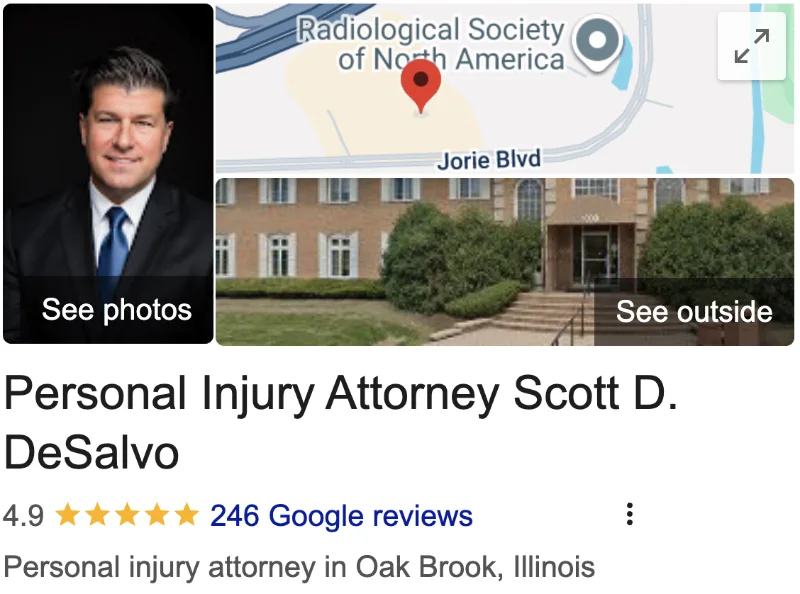
1000 Jorie Blvd Ste 204
Oak Brook, IL 60523
New Cases: 312-500-4500
Office: 312-895-0545
Fax: 866-629-1817
service@desalvolaw.com
Chicago and Other Suburban Offices
By Appointment Only