
Wood Dale is a small city that carries a big industrial footprint — manufacturing and distribution plants, the businesses feeding nearby O'Hare, and the commuter traffic that moves along Irving Park Road and Wood Dale Road and through the Metra station every day. That blend of heavy industry and steady traffic is good for the local economy and hard on the human body, and when someone gets hurt, the insurer across the table is almost always a large company that has never set foot here.
I'm Scott DeSalvo. For almost 30 years I've represented injured people across DuPage County, taking a limited number of cases so each one gets real attention. If you were hurt in Wood Dale — on the road, on the job, or on someone's property — here's what you should understand before an insurance adjuster reaches you. Learning it is free.
Wood Dale's size doesn't shrink your claim. The insurance company handling it runs the same playbook it uses everywhere: be friendly, move fast, and settle for the least it can while you're still figuring out how hurt you are. It answers to shareholders, not to you. What levels that fight is a lawyer who knows those tactics and knows DuPage County's courts — not a name on a template page written a hundred miles away.

The industrial base means real workplace injuries — machinery, forklifts, repetitive strain, falls on the plant floor. The roads mean crashes: Irving Park Road and Wood Dale Road carry steady traffic, and the nearby expressways and O'Hare corridor bring faster, heavier vehicles into the mix. Commercial buildings and older properties bring their own fall hazards. Knowing how people actually get hurt in a town like this is part of building a case that stands up.
My practice covers the full range of serious injury claims for Wood Dale residents and workers:
From collisions on Irving Park Road to wrecks near the expressways and O'Hare corridor, motor vehicle cases are the ones I handle most.
Wood Dale's factories, warehouses, and distribution jobs all carry real risk, and Illinois workers' compensation is a separate system with rules of its own.
Wet floors, icy lots, and neglected stairs cause serious injuries, and older residents in particular can suffer lasting harm.
When a provider's mistake causes real harm, these are the toughest injury cases to win, and I take them on when the evidence is there.
Wooddale Medical Negligence Lawyer
Serious, preventable harm to a resident in a care facility is protected under a specific Illinois statute.
Wooddale Nursing Home Abuse Lawyer
When a preventable death occurs, Illinois gives the surviving family a path to accountability.
Real compensation reaches well past your medical bills. Depending on the injury, Illinois law lets you recover past and future treatment, lost income and any lasting damage to your earning ability, physical pain, and the loss of your normal life — plus the value of permanent effects, scarring, and disability. I won't put a number on your case before I understand it, but I will pursue every category you're owed.
You pay nothing out of pocket. I take injury cases on contingency, so my fee comes only from what I recover, and I advance the costs along the way. Standard personal injury cases are 33 1/3% (40% if we litigate), workers' compensation is capped by Illinois law at 20%, and medical malpractice is 33 1/3%. Lose, and you owe nothing.
Trial training matters even for a case you hope settles, because insurers pay more, and faster, when they know your lawyer is genuinely ready for a courtroom. I'm a graduate of Gerry Spence's Trial Lawyers College and the Keenan Trial Institute, and that preparation is what produces stronger settlements — never something you'd have to use. I'm reachable 24/7, because injuries don't keep a schedule.
The window to act is limited. Most personal injury claims run two years from the injury; workers' compensation allows three years but usually requires notice to your employer within 45 days; medical malpractice runs two years from discovery with a hard four-year cap; and claims against a city or government body can be far shorter. Once a deadline passes, the case is over — which is why an early, free call matters even before you've decided anything.
Call me and tell me what happened at work. I'll explain exactly what you're owed, flag whether there's a second claim hiding in your case, and tell you what to do next. It's free, and you pay nothing unless I recover for you — capped at 20% by Illinois law.
I answer the phone 24/7. Call 312-500-4500.
"Scott is absolutely fantastic. He will always go the extra mile for his clients. They always take the time to return phone calls at all hours and I highly recommend him to all my friends."
-Melissa Brooks
"Great people and Scott's a great lawyer. They helped me make the wisest decision for my case, and that's important in serious legal matters. I trust him completely. He is the one to call."
-Tony Skvarenina
"Beyond satisfied with the services I received from this law firm. Definitely recommend! They got me fully paid and all the doctor bills, too. If you want the best, this is the law firm for your injury case!"
-Cynthia Rodriguez
"Scott represented me and I was really pleased with everything, my car accident paid a lot and quick. If you want a good Lawyer who is responsive, and straight with you, I highly recommend him."
-Greg Garcia
If you've fully recovered and no insurer is involved, maybe not. But if you missed work, needed ongoing care, or an insurance company is in the picture, a free call before you accept anything is worth your time. Insurers often treat suburb claims as easy wins, betting that you'll assume you don't need help — and that assumption is what costs people.
Most personal injury claims give you two years from the injury. Workers' comp allows three years but usually requires notifying your employer within 45 days, and medical malpractice has its own two-year and four-year limits. Claims against a government body can be much shorter. Since the exceptions are easy to miss, ask early.
Nothing up front, and nothing unless I win. I work on contingency, so my fee comes only from money I recover, and I advance the case costs myself. If there's no recovery, you owe nothing.
Because local knowledge and real attention change outcomes. A firm running a templated page about your town often won't know its roads, its hazards, or the DuPage County courts — and it may handle cases in volume. I take fewer cases and know this county, which is what your claim actually needs.
Almost certainly not — the vast majority settle. But settling well depends on the insurer believing your lawyer is prepared to go to court if they lowball you. That readiness is what produces a fair settlement without a trial.
As soon as you reasonably can. Evidence disappears, records get overwritten, and deadlines run. An early call doesn't commit you to anything — it simply keeps your options open while everything is fresh.

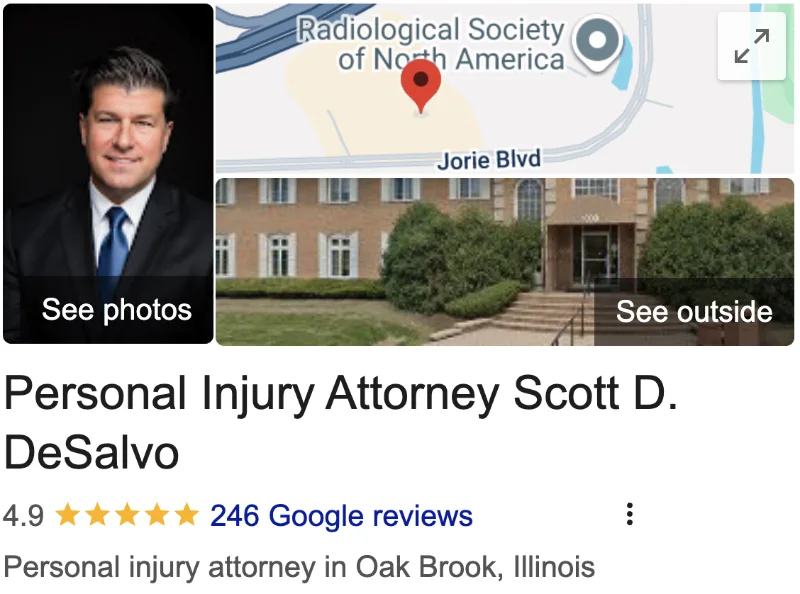
Scott DeSalvo founded DeSalvo Law to help injured people throughout Chicago and surrounding suburbs. Licensed to practice law in Illinois since 1998, IARDC #6244452, Scott has represented over 3,000 clients in personal injury, workers compensation, and accident cases.
No Fee Unless You Win | Free Consultation | 24/7 Availability Call or Text: (312) 500-4500
>>Read More
Main Office:
1000 Jorie Blvd Ste 204
Oak Brook, IL 60523
New Cases: 312-500-4500
Office: 312-895-0545
Fax: 866-629-1817
service@desalvolaw.com
Chicago and Other Suburban Offices
By Appointment Only